The post PRAKRUTI first appeared on Maria Garre.
The post PRAKRUTI appeared first on Maria Garre.
]]>
Self-discovery through Ayurveda.
One of the many gifts of Ayurveda is that it helps us comprehend who we were MEANT to be, not WISH to be.
PRAKRUTI
A profound journey in self-transformation to acceptance and celebration.
When you begin from the start, then you bow down to the miracle of your body. This body is nothing without the light of the Soul. For it was the Soul that entered your womb to make the egg and sperm viable for life. A Divine gathering indeed.
The Soul brings the spark of life which drives the reproductive tissue to mold an earthen body. This is You, me, us. Five elements from subtle to gross comprise who we are. Life is a tripod of the mind, the body, and the Light of Life.
Ayurveda’s tri-dosha model offers a practical application and guide for us to live by honoring the teachings of life.
It is why Ayurveda’s approach to individualized medicine over the past 5,000-plus years is still at the forefront of BEST medicine practices for healing and wellness. You are unique and thereby your both medicine and lifestyle are also singular per individual.
PRAKRUTI – your ayurvedic constitutional as it is often translated to, simply is who you were meant to be. Understanding our Prakruti offers insight and lifelong exploration to maintain health and total well-being.
When you understand our body just a little better and how to support it, rather than fight it, the conversation shifts. Your mind finds clarity. There is an inner sense of home and inner knowing. At least that is how it has felt for me and many of the humans I am honored to support and teach the teachings.
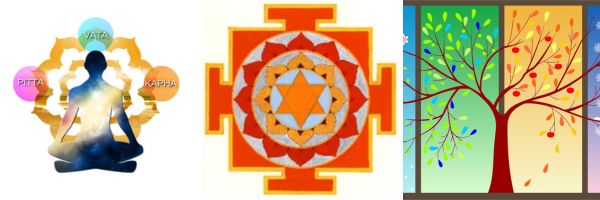
Vata, Pitta and Kapha. They are the active principles of the Soul that manifest through your body and mind in different ways. From blood to energy, Ayurveda links the whole body through the tri-dosha model so you can see and understand your life. This is why the wise Sages left us this brilliant medicine. To serve and support the journey of life (Ayur).
READY TO EXPLORE AND GET TO YOU KNOW YOURSELF?
Dive deeper into the famous Dosha test and get to the core of who you truly are. I HIGHLY recommend you give these questions to a parent or parent-like person or your BFF to help evaluate and take the average of several scores.
DOWNLOAD MARIA’S DOSHA ASSESSMENT
The post PRAKRUTI first appeared on Maria Garre.
The post PRAKRUTI appeared first on Maria Garre.
]]>The post Dosha Dharma: Divine Destiny first appeared on Maria Garre.
The post Dosha Dharma: Divine Destiny appeared first on Maria Garre.
]]>Ayurveda’s tri-dosha model for health teaches that each Dosha has duties and responsibilities toward maintaining the body’s health. The model states we have our own unique Doshic make-up called Prakruti. Prakruti is who you are meant to be. Prakruti teaches and explains the unique make-up of who we are, as well as how to maintain balance and health. As you get to know your unique constitutional qualities you begin to make better decisions. From what to eat, to how to exercise, dress, and work, to understand Prakruti is a phenomenal resource.
Self-care can only begin when we actually know who we are!
For now, I’d like to introduce you to each Dosha that is supporting your entire health and well-being. When not in balance, it disturbs and disrupts their ability to do their jobs. Imbalanced Dosha becomes ill-health or disease, eventually.
The Will of Vata
Vata’s Dharma is TO MOVE.
VA-ta comes from the Sanskrit Verb root VA = move, to go and is related to the Vahi which means vehicle.
Vata’s destiny is to move, to rock& roll. To expect otherwise is to not understand what Vata is here to do. Without Vata, there would be no movement. Power to the Movement – Go Vata, Go!
Vata is the superfine essence of Prana, the throbbing pulse of life. Like ghee is the superfine essence of the cow, Prana is the finest particle of Vata. The animating life force that generates life through pulsation, vibration.
The psychophysiology of Vata lies in its association with Space and Air within the biology of the body. Vata supports the body as the essence of movement. From defecation to speech + heartbeat, Vata is behind the scenes. The movement of our nervous system, feelings and thoughts, touch, and hearing are all under the domain of Vata. From the moment of your cells to muscles and bones, Vata is the one. For Vata is the prime mover of ALL!
Vata in nature is the wind and sky above. This is why Vata loves to look up! All the possibility lies in the space above. Think of the Hummingbird. This admired joyful creature is a wonderful Vata archetype: light, quick, and entertaining. Meanwhile, the snake in Ayurveda often personifies Vata’s pulse as quick and shifting. Vata’s nature is to move, to create, to rise up, to spring forward!
To note is that movement has a direction. It’s not chaotic or all over the place. Vata moves with direction, intention, clarity, and at the right speed. Air can swiftly change direction and speed but not in a frazzled way. Clear communication and expression are the gifts. Moving the world in the right way at the right speed at the right time.
The Pitta Mission
Pitta’s Dharma is to transform.
Pi – tta comes from the Sanskrit root of TA-pas which means “to heat, to shine”. Thus Pitta is here to SHINE, to LIGHT up the world.
But, put your sunglasses on, because all that light can make those Pitta eyes red, sensitive, and photophobic.
Pitta is the superfine essence of Tejas, the intelligence and wisdom of the body. The pure part of the flame that brings the aura and glow to the fire.
However, PItta is not just the fire element and many forget. In our body, Pitta is the amalgamation of water and fire. The psychophysiology of Pitta is liquid fire: from enzymes to blood, bile, hydrochloric acid, and intelligence. The nature of this liquid fire is to transform whatever comes it’s way. Pitta is best seen as the luminous Sun, pulsing like a ball of hot radiant liquid. Brings light and warmth. In the animal kingdom, Pitta can be a Fire Dragon, burning and transforming all on the path. But also delicate like a fox. The pulse of Pitta is a like a frog. Jumping and pushing into the fingertip. Pitta rules the blood and we feel the pulse of the doshas within the vessel of the radial artery.
Piita’s nature is fire, but not to burn itself. Biologically it is the metabolizer of all. From vision and thoughts to food, we take in the world and must digest what we eat and experience. The digestive process of transforming it is the domain of Pitta. Transforming darkness to light, water to vapor and so on the job of Pitta is to heat and cook.
The Kapha Offering
Kapha’s Dharma is to lubricate, to nourish via fluid and fluidity. Go with the flow.
The Sanskrit word Ka-Pha itself means “to flourish in water”. Thus, Kapha’s main role in the body is to bring the fluid essence to all of our tissues.
Kapha is also the super-fine essence of Ojas, the fluid nectar of fertility, vitality, and immunity. Ojas is often compared to Soma, the sacred nectar of immortality offered to the Gods.
But let’s not get lost in the poetry, Kapha’s psychophysiology in the blend of Earth and Water. It brings both fluidity and strength. From the moisture of the skin, and the strength of our muscles and ligaments, to the lubrication of our joints, Kapha offers fortitude and stamina to our whole being. The very nature of Kapha is to protect, strengthen, build, grow, and repair. From sinuses to lymph and phlegm, the liquid stability of strength is there to nourish.
In nature, the essence of Kapha is captivated by the mountains, the ocean, rivers, cloudy/rainy days, snow, and elephants. The pulse of Kapha is that of a swan, gliding, swaying into the fingertips.
The Earth holds us and gives us the structure we need, water brings life and food. This is the very essence of Kapha. Giving, compassion, fluidity, and tranquility are hallmarks of this Dosha.
There is much to say about each Ayurvedic Dosha, especially at a clinical level. This is a creative, evolving rendition of how I’ve come to relate to each Dosha through Dharma, not just through text but through self-exploration. n my special program called Prakruti and together let’s discover who you were meant to be!
Ready to dive in and explore your Prakruti? Let’s Meet.
The post Dosha Dharma: Divine Destiny first appeared on Maria Garre.
The post Dosha Dharma: Divine Destiny appeared first on Maria Garre.
]]>The post Ayurveda 101: Ancestral Healing first appeared on Maria Garre.
The post Ayurveda 101: Ancestral Healing appeared first on Maria Garre.
]]>
The Sister Science of Yoga
AYURVEDA 101: ANCIENT HEALING FOR MODERN LIVING
by Maria E Garre
Ayurveda is a Sanskrit word that brings together two root words to form one: Ayur meaning life and Veda meaning supreme knowledge or wisdom. Thus, Ayurveda is known as the science or wisdom of life.
Written evidence dates Ayurveda to 3000 BC making it over five thousand years old; and hence the oldest, uninterrupted system of medicine to be practiced in the world. Rooted in Vedic culture, with references to Ayurvedic practices in the Vedas (specifically the Rig Veda and Atharva Veda), Ayurveda has been healing mankind for thousands of years, yet modern culture is just now waking up to its benefits.

Ayurveda’s foundational concepts are based upon the Tri-Doshic theory of Vata, Pitta, and Kapha (the three Doshas) as well as Prakriti and Vikruti. Every person is a unique amalgamation of the five physical elements (space, air, fire, water, and earth). Through the law of cause and effect, each element exerts its influence upon our body and mind through its respective properties, the gunas. Very simply stated, the elements are present in everyone and everything; however they come together to create three bodily doshas. Vata is primarily composed of space and air; bringing dry, light, mobile, and clear qualities. Pitta is mostly fire and water; creating hot, sharp, oily, and spreading effects. Kapha contains mostly water and earth; offering heavy, stable, smooth, and static qualities to the individual. The three doshas form the premise of Prakriti, your unique, innate essential constitution, which is determined at conception. This determines who we are and also defines the natural expression of balance, health, and happiness for complete well-being.
However, this balanced state can be disturbed and create an imbalanced state, Vikruti. If we remain in a state of imbalance for too long then it can lead to health problems, disease, and/or mental unrest. Many factors influence our daily lives to create imbalance, such as lifestyle and dietary choices, seasonal influences, and emotions. Prolonged and unmanaged situations, which stress the body or mind, will eventually jeopardize our natural, healthy, and balanced state (Prakriti) which then leads to Vikruti. For example, if in the middle of Winter, we are traveling a lot, eating salads, and not sleeping well then according to Ayurveda, Vata dosha will be aggravated due to the principle of “like increases like”. This means that we are increasing qualities within the body that will disturb our natural state and thus eventually lead to a disease condition. In this example, the person could be plagued with health problems ranging from poor circulation, cracking and popping joints to anxiety or constipation depending upon the individual.
How do we solve the problems created by imbalanced states?
Here is some good news! Ayurveda offers us various lifestyle, seasonal, and dietary practices that can help guide not just our day-to-day living but also guide the way we exercise or practice Yoga. Returning back to the Winter/Vata Dosha example and Ayurveda’s primary axiom of like increases like and opposite heals, an Ayurvedic Practitioner can quickly ascertain that the qualities of space and air, akin to Vata dosha, are creating an imbalance within the person’s main constitution of Vata. To alleviate any of the above symptoms, we would encourage the individual to adopt opposite dietary and lifestyle choices like eating warm cooked foods that are moist and oily; covering the head, back of the neck, and lower back to protect from cold air; and keeping to a consistent sleeping routine, for example. According to Ayurveda, all of these measures would minimize the condition at hand that is creating discomfort or illness. In addition to lifestyle practices, Ayurvedic practices also include an arsenal of body therapies and herbal protocols to bring health when there is a disease.
Ayurveda not only offers a way to heal naturally through lifestyle and dietary choices but also has potent medicines and herbs that heal the body without the adverse effects of most allopathic medicines. But the most revolutionary thought process in Ayurveda is centered upon the premise that there is a root cause for all diseases and most of the time the root cause revolves around our lifestyle and dietary choices.
The post Ayurveda 101: Ancestral Healing first appeared on Maria Garre.
The post Ayurveda 101: Ancestral Healing appeared first on Maria Garre.
]]>